
Imagine having a digital team member that can monitor tasks, analyse information, respond to customers, follow up with leads and even take action without waiting for someone to tell it what to do. That is the shift businesses are beginning to experience with AI agents.
Artificial intelligence is no longer limited to chatbots that answer questions or tools that generate content. In 2026, businesses are increasingly exploring AI agents that can understand a goal, decide what steps are needed and complete parts of a workflow with limited human intervention.
This shift is changing how companies approach productivity, customer experience, marketing and everyday operations. Gartner has predicted that 40% of enterprise applications will include task-specific AI agents by the end of 2026, compared with less than 5% in 2025.
For businesses, the bigger question is no longer simply “should we use AI?” It is “Where can AI agents create meaningful business value?”
At tsh.media, we help businesses explore how AI, digital marketing and emerging technologies can support smarter growth. Let’s explore what AI agents mean for businesses in 2026 and why they are becoming an important part of digital transformation.
What Are AI Agents?
AI agents are software systems designed to work toward a specific goal. Unlike a basic chatbot that primarily responds to a prompt, an AI agent can handle a sequence of tasks, make decisions within defined boundaries and interact with other business tools.
For example, a traditional chatbot might answer: “What is your return policy?”
An AI agent could potentially understand a customer’s return request, check the relevant order information, determine whether the request meets the company’s policy, initiate the next step and escalate the case to a human when necessary.
In simple terms, AI agents can move businesses from asking AI for answers to allowing AI to help execute work.
This is one reason AI agent technology is attracting attention across sales, marketing, customer service, finance and operations.
Why Are AI Agents Becoming Important in 2026?
Businesses are under constant pressure to do more with limited time and resources. Customers expect quick responses, employees spend significant time on repetitive tasks and marketing teams need to react faster to changing customer behaviour.
AI agents can address some of these challenges by supporting workflows instead of simply generating information. Google Cloud’s 2026 research highlights agentic AI trends around productivity, business workflows, customer experiences, security and developing an AI-ready workforce.
The result is a broader approach to AI business transformation in 2026, where AI becomes part of how work gets done rather than an isolated tool used by a few employees.
Ways AI Agents Are Transforming Businesses in 2026
1. Automating Repetitive Business Tasks
Every business has tasks that consume time without necessarily requiring strategic thinking. Data entry, report preparation, appointment scheduling, email follow-ups, lead qualification and routine customer queries are common examples.
AI agents can help manage these repetitive workflows, allowing employees to spend more time on work that requires creativity, judgement and human interaction. The objective isn’t simply to replace human work. In many cases, it is about reducing the amount of repetitive work employees have to perform manually.
2. Making Customer Support Faster
Customers increasingly expect businesses to respond quickly, regardless of the time of day. AI agents can support customer service by handling common questions, finding relevant information and routing complicated issues to the appropriate team member.
For example, an ecommerce business could use an AI agent to check order information, answer delivery questions and initiate a support request. Human employees can then focus on situations requiring empathy, negotiation or deeper problem-solving.
This combination of AI speed and human judgement can create a more responsive customer experience.
3. Changing Sales and Lead Management
Sales teams often spend considerable time identifying prospects, updating customer records and following up with leads. AI agents for business can help streamline these activities.
An agent could review incoming leads, organise them based on predefined criteria, identify potential follow-up opportunities and assist with personalised communication.
Instead of salespeople spending hours sorting through prospects, they can focus their attention on conversations that are more likely to turn into meaningful opportunities.
This doesn’t mean AI should make every sales decision. Human oversight remains important, particularly when decisions involve customer relationships, pricing or sensitive information.
4. Transforming Digital Marketing
Marketing is one of the areas where AI agents can have a particularly interesting impact. Modern marketing involves multiple moving parts: SEO, paid advertising, social media, email campaigns, content, analytics and customer research.
AI agents can help marketing teams monitor campaign performance, identify unusual changes, analyse data and support routine optimisation.
For example, an AI-powered workflow could monitor campaign metrics and alert a marketer when performance changes significantly. Another agent could assist with audience research or organise insights from multiple sources.
Marketing professionals still provide the strategy and creative direction. AI simply helps them move faster. For a digital marketing agency in Mumbai, this evolution creates opportunities to combine human strategy with AI-assisted execution across different marketing channels.
5. Improving Business Decision-Making
Businesses generate enormous amounts of information every day. The challenge is often not collecting data but turning it into something useful. AI agents can help bring information together, identify patterns and present insights in a way that is easier for teams to understand.
Imagine a business owner receiving a simple summary that highlights:
- Which marketing channel generated the most qualified leads
- Where website conversions dropped
- Which products are receiving increased interest
- Which campaigns require attention
- What customer questions are appearing most frequently
Instead of manually checking several dashboards, decision-makers can receive relevant insights in a more accessible format.
The final decision, however, should remain with people, especially when the decision has significant financial, legal or reputational consequences.
What Are the Challenges of Using AI Agents?
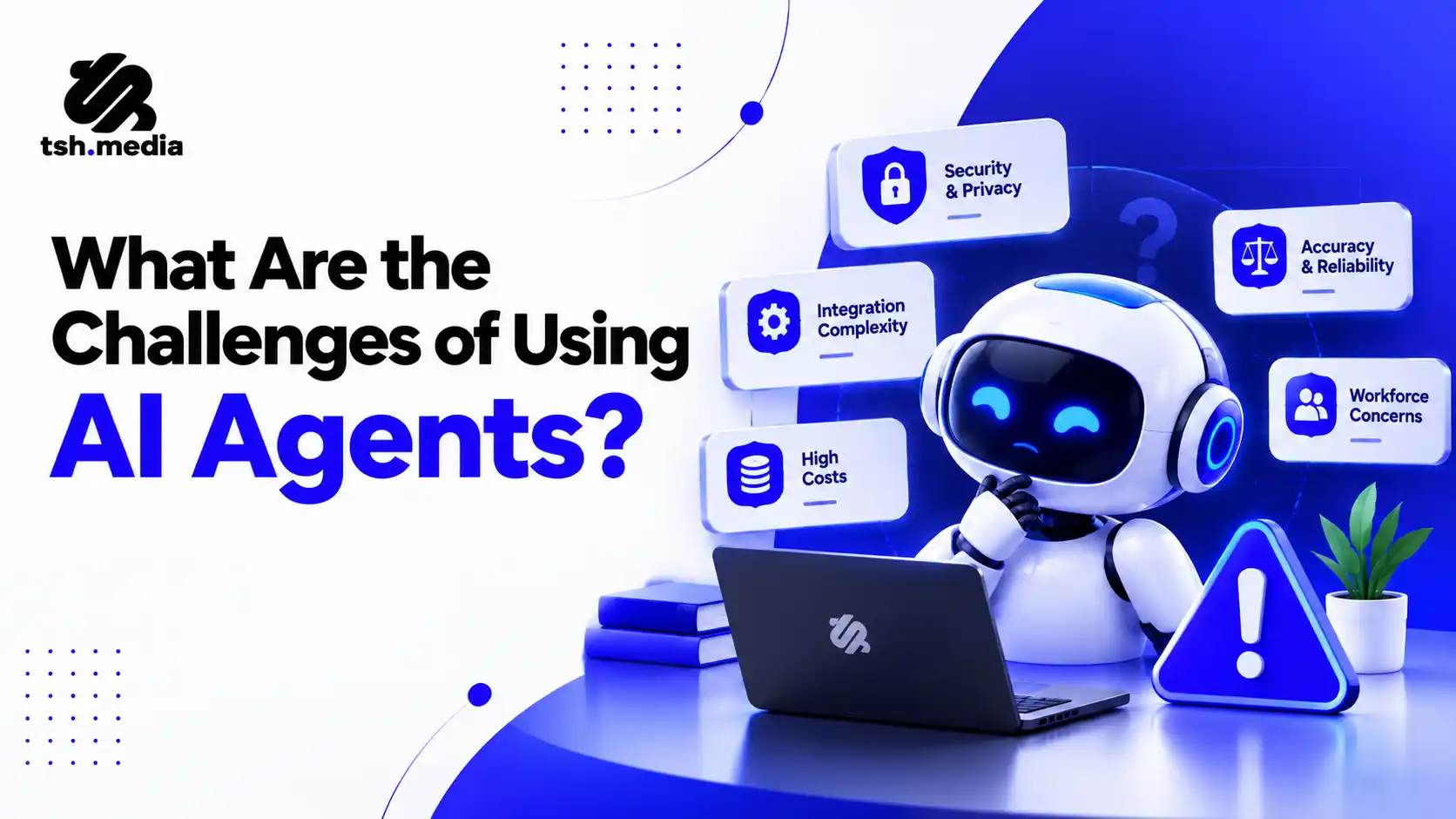
AI agents can offer significant benefits, but businesses shouldn’t adopt them simply because AI is trending. There are several factors to consider.
1. Data and Privacy
AI systems may interact with business and customer information. Companies need clear rules around what information agents can access and how it is handled.
2. Accuracy
AI can make mistakes. Businesses should establish review processes, particularly for customer-facing, financial or high-impact activities.
3. Human Oversight
Not every decision should be automated. Employees need the ability to review, correct or stop an AI-driven process when necessary.
4. Clear Business Goals
The best AI implementation starts with a business problem, not with a technology trend. A company should first ask: What process is slowing us down, and can AI improve it safely?
This approach helps businesses focus on measurable outcomes rather than adopting AI for the sake of adoption.
What Does the Future of AI Agents Look Like?
The next phase of AI is likely to involve more specialised agents working across different business functions. Instead of relying on one general-purpose system, businesses may use different agents for marketing, customer service, sales, research and internal operations.
Industry discussions in 2026 are already pointing toward coordinated multi-agent workflows and deeper integration with existing business processes. But the companies that benefit most won’t necessarily be the ones using the most AI.
They will be the ones using it thoughtfully. The future isn’t about humans versus AI. It is about building smarter workflows where technology handles repetitive execution while people bring strategy, creativity, experience and judgement.
Conclusion
AI agents are changing the conversation around business automation. From customer support and sales to marketing and decision-making, they can help organisations reduce repetitive work, respond faster and make better use of their teams.
But successful adoption requires more than choosing an AI tool. Businesses need clear objectives, appropriate safeguards, human oversight and a focus on measurable results. For companies exploring the next stage of digital growth, AI agents are becoming an important part of the conversation.
At tsh.media, we believe the strongest digital strategies combine emerging technology with human insight. As AI continues to evolve, businesses that learn how to use it strategically, not blindly, will be better positioned to adapt, compete and grow.
Connect with tsh.media to explore a smarter, AI-ready digital growth strategy for your business.
FAQs
1. What is AI agent technology?
AI agent technology enables software to work toward defined objectives rather than simply responding to individual instructions. Depending on the setup, an agent can plan tasks, use business information, take actions and request human assistance.
2. How are AI agents transforming businesses in 2026?
AI agents are transforming businesses by automating repetitive workflows, improving customer response times, supporting marketing and sales teams, analysing information and helping employees focus on higher-value strategic and creative work.
3. What are the benefits of AI agents for businesses?
Key benefits include faster workflows, reduced repetitive work, improved customer responsiveness, better access to business insights and greater employee productivity. The actual benefits depend on the use case, implementation and level of human oversight.
4. Are AI agents replacing employees?
AI agents are primarily being used to support and automate specific tasks rather than replace entire roles. They can reduce repetitive workloads while employees continue handling strategy, creativity, relationships, judgement and complex decision-making.
5. How can small businesses use AI agents?
Small businesses can use AI agents for tasks such as lead qualification, customer enquiries, appointment scheduling, reporting, follow-ups and marketing support. Starting with one measurable workflow can make AI adoption more manageable.