
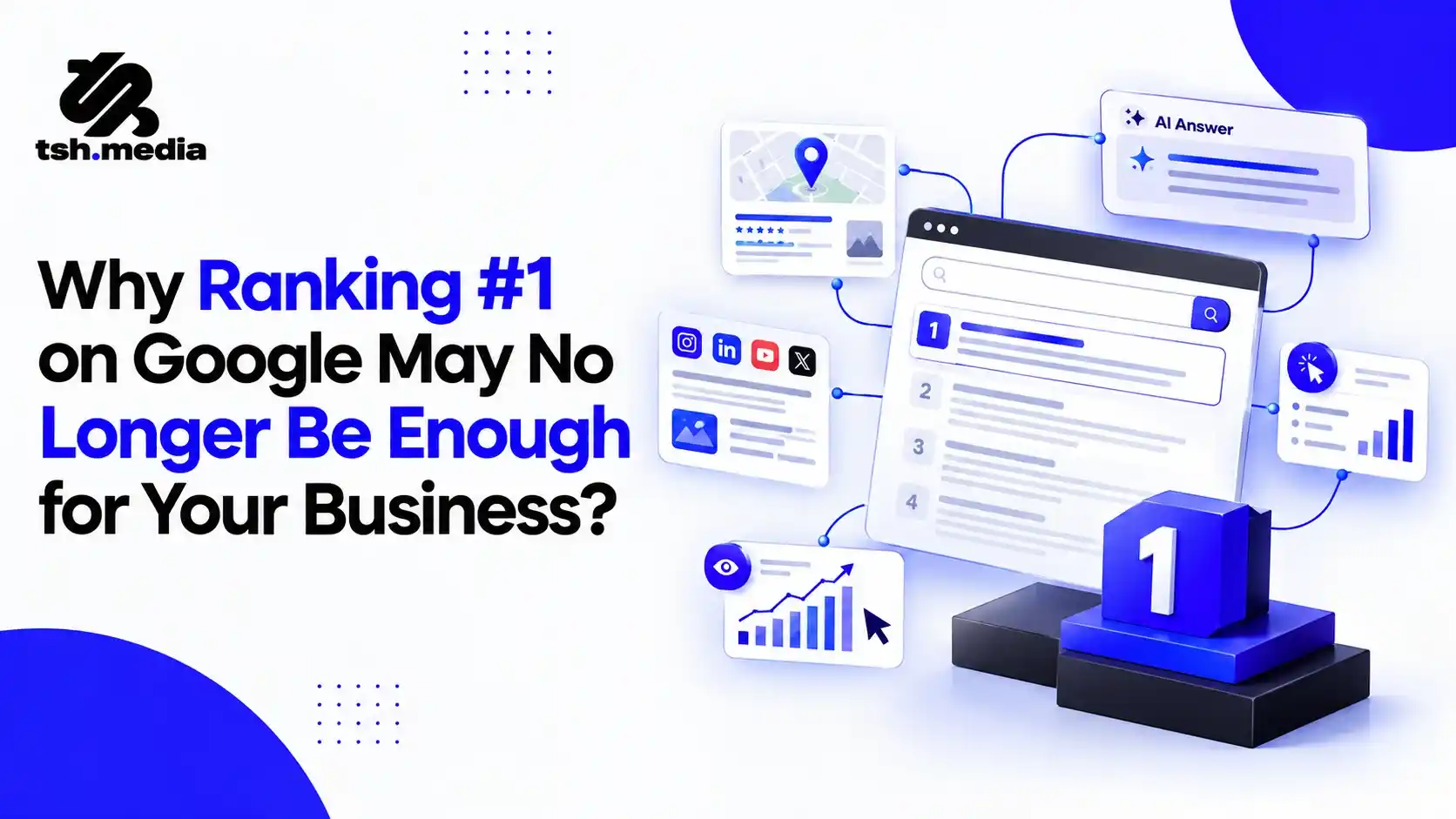
For years, ranking at the top of Google has been one of the clearest signs that your SEO strategy was working. A #1 position meant more visibility, more clicks and, ideally, more customers.
But search has changed. Today, someone searching for a service may see an AI-generated answer, local results, videos, ads, maps, shopping results, featured content and traditional organic listings, all on the same search journey. Google itself says that its AI Overviews and AI Mode are designed to help people explore complex questions while providing links to supporting websites.
That means being #1 is still valuable, but it is no longer the entire goal.
Businesses now need to think beyond where they rank and focus on how visible they are, whether people trust them, whether they get chosen and whether that visibility produces meaningful business results.
What Has Changed About Google Search?
Traditional SEO often revolved around a relatively simple idea:
Search → Ranking → Click → Website → Conversion
That journey is no longer always so straightforward.
A potential customer might search:
“Best digital marketing agency for a growing business”
Instead of immediately clicking the first organic result, they may read an AI-generated summary, compare several companies, check reviews, visit Google Business Profiles, explore social media and then search for a specific brand.
Google’s current guidance confirms that AI Overviews and AI Mode can surface links from a wider range of relevant websites, creating new opportunities for businesses to be discovered beyond a conventional blue-link ranking.
So the modern customer journey may look more like:
Search → AI answer → Brand discovery → Reviews → Website → Comparison → Enquiry
This is why businesses need a broader definition of search visibility.
A #1 Ranking Does Not Automatically Mean More Customers
Imagine your website ranks first for an important keyword. That’s excellent, but what happens next?
If your title does not attract attention, people may skip the result. If your website does not answer their questions clearly, they may leave. If competitors have stronger reviews, clearer service information or greater brand recognition, users may choose them instead.
In other words, ranking creates an opportunity. It does not guarantee a conversion.
Google also states that search results are determined by relevance and quality, with factors such as the user’s query, location, language and device influencing what appears.
For businesses, this means SEO reporting should move beyond a single question: “What position are we ranking at?”
A better set of questions is:
- Are the right people finding us?
- Are our pages receiving relevant impressions?
- Are users clicking?
- Are visitors engaging with the website?
- Are people contacting the business?
- Are we appearing in AI-powered search experiences?
- Are our brand and expertise being discovered across multiple search journeys?
Search Visibility Is Becoming Bigger Than Traditional Rankings
The modern search results page contains many ways for a business to become visible.
Your brand may appear through:
- Organic Search: Traditional organic rankings remain an important foundation. Strong SEO helps search engines understand your website, services and expertise.
- Google Business Profile: For location-based searches, your Google Business Profile can influence how potential customers discover your business, view reviews, find directions and make contact.
- AI Overviews and AI Mode: Google’s AI-powered search experiences can provide answers while linking users to supporting websites. Google says existing SEO fundamentals remain relevant for these experiences.
- Branded Search: A person may discover your business through one channel and later search specifically for your brand. This is an important sign that visibility is contributing to awareness.
- Content and Social Discovery: Blog posts, videos, case studies, social media content and other useful resources can introduce your business before someone is ready to buy.
The result is a much broader concept of search visibility.
Why AI Is Changing the SEO Conversation
AI is not replacing SEO. It is changing where and how people discover information. Google’s 2026 guidance specifically states that SEO remains relevant for generative AI search because these experiences are connected to Google’s existing search and quality systems.
For businesses, this creates a new opportunity: become a source that is genuinely useful. A strong SEO strategy for modern search can help businesses improve their visibility while keeping content focused on real customer needs. That means publishing content that answers real customer questions, demonstrates experience and provides information that is more useful than a generic summary.
For example, instead of publishing another article titled “10 Benefits of Digital Marketing,” a digital marketing agency could publish:
- A campaign breakdown showing what was changed and why
- A comparison of SEO and paid advertising for different business goals
- Common reasons Google Ads receive clicks but few enquiries
- Practical examples of how businesses can prepare for AI-driven search
- A guide explaining what business owners should actually measure from SEO
This type of content gives readers something they can use.
Google’s guidance emphasizes unique, valuable, people-first content rather than content created primarily to manipulate rankings.
From SEO to Business Visibility
The next stage of SEO is not about abandoning rankings. It is about putting rankings into context.
A page ranking #1 for a keyword with almost no commercial value may contribute less to the business than a page ranking lower for a highly relevant search that consistently generates enquiries.
For example:
- Keyword A: 10,000 monthly searches, but very low buying intent.
- Keyword B: 800 monthly searches, but users are actively looking for a service provider.
A business should not judge these opportunities using search volume alone.
The more useful question is: Which visibility is helping the business move closer to a customer?
That is where SEO, content, conversion optimization, local search, paid media and brand building start working together. Businesses investing in paid search can also compare Performance Max vs Search campaigns based on their goals, audience and campaign structure.
What Should Businesses Track Instead of Rankings Alone?
Rankings should still be monitored, but they should be part of a larger performance picture.
- Impressions: Impressions show how often your pages are being shown in search. They help identify whether your overall visibility is expanding.
- Relevant Clicks: A large amount of traffic is not necessarily useful if it comes from irrelevant searches. Look at whether visitors match your target audience.
- Engagement: Time spent on important pages, page interaction and movement through the website can help you understand whether visitors are finding what they need.
- Leads and Enquiries: For service businesses, calls, enquiry forms, WhatsApp conversations and consultation requests may matter far more than a ranking position.
- Conversions: Ultimately, SEO should support business outcomes. Track which organic pages and search journeys contribute to enquiries, sales or other meaningful actions.
This gives businesses another useful layer of visibility to monitor.
Where AI Agents for Business Fit In
The next shift may go beyond AI-generated answers. AI agents for business are designed to perform tasks on behalf of users. Google’s current guidance describes agentic experiences as systems that can perform tasks such as booking reservations or comparing product specifications.
This matters because websites may increasingly need to be easy for both humans and AI-driven systems to understand.
For example, a potential customer could eventually rely on an AI agent to compare agencies, services, pricing information, reviews or available options before making a decision.
That makes clear information increasingly important.
Businesses exploring AI agent technology should therefore think about how easily their services, products, policies and business information can be understood and acted upon.
AI Business Transformation in 2026 Is Bigger Than Automation
The conversation around AI business transformation 2026 should not be limited to using AI to write content faster. Real transformation involves changing how a business attracts, understands and serves customers.
For marketing teams, this can mean using AI to identify search trends, analyze customer questions, personalize experiences, improve campaign analysis and uncover content opportunities.
But human expertise still matters. AI can help process information quickly. It does not automatically understand your customers, your market, your positioning or your business experience.
That combination, technology plus genuine expertise is where businesses can create stronger digital experiences.
What Should Your SEO Strategy Look Like Now?
A modern SEO strategy should connect several pieces:
Strong SEO foundation + useful content + brand visibility + local search + AI search readiness + conversion tracking
At tsh.media, we believe SEO should be connected to the wider digital marketing picture rather than treated as a race for one keyword position. The goal is to help businesses become easier to discover, easier to understand and easier to choose.
That means creating useful content, improving search visibility, understanding customer intent and measuring the actions that matter to the business.
Conclusion
Ranking #1 on Google is still an achievement. It can bring valuable visibility and qualified traffic. But search has become more diverse.
People now discover businesses through traditional search results, AI-powered experiences, local listings, branded searches, content and multiple digital touchpoints. Google’s own guidance confirms that SEO fundamentals remain important for AI-powered search while emphasizing useful, original and people-first content.
So don’t stop tracking rankings. Just stop treating them as the only definition of SEO success.
The better question is no longer simply “Are we ranking #1?”
It is: “Are the right customers discovering us, understanding our value and taking action?”
That is the kind of search visibility that can contribute to real business growth.
FAQs
1. Why is Google ranking alone not enough for SEO success?
A ranking does not guarantee clicks, engagement or enquiries. Searchers may encounter ads, local listings, AI-generated answers and competing brands before visiting your website. Business-focused SEO therefore measures visibility together with meaningful actions.
2. How is AI changing Google Search?
AI-powered features can summarize information and provide supporting links, changing how users discover websites. Google says existing SEO fundamentals remain relevant, while useful, original and people-first content remains important for visibility.
3. What should businesses measure besides keyword rankings?
Businesses should monitor impressions, relevant clicks, engagement, leads, conversions, branded searches and visibility across search features. For eligible sites, Google Search Console also provides dedicated insights into visibility within generative AI experiences.
4. What is AI business transformation in 2026?
AI business transformation in 2026 involves using artificial intelligence across areas such as marketing, customer service, analysis and operations. The strongest approach combines AI capabilities with human expertise, business knowledge and customer understanding.
5. How can a digital marketing agency help with modern search visibility?
A digital marketing agency in Mumbai can connect SEO, content, local search, paid campaigns, conversion optimization and analytics into one strategy. This helps businesses focus not only on rankings, but also on qualified traffic, enquiries and measurable growth.