
TL;DR
If you want your website to appear in ChatGPT, Gemini, Perplexity, and Google AI Overviews, stop chasing AI hacks and start building a website that genuinely helps users. Focus on creating helpful content, improving your website’s technical SEO, implementing structured data, strengthening EEAT, publishing original research, and ensuring your website is fast and mobile-friendly. At TSH Media, we’ve helped multiple brands improve their visibility across AI-powered search by combining traditional SEO with Generative Engine Optimization (GEO), a user-first strategy designed for the future of search.
How to Optimize Your Website for ChatGPT, Gemini & Perplexity
The rise of AI-powered search has changed how people discover businesses online.
Instead of typing short keywords into Google, users are asking conversational questions like:
- Which digital marketing agency is best for my business?
- How can I improve my website for AI search?
- What’s the difference between SEO and AI SEO?
- How do I get my website mentioned in ChatGPT?
Rather than showing a list of links, AI platforms such as ChatGPT, Gemini, Perplexity, and Google AI Overviews generate complete answers by referencing trustworthy websites.
So, how do you optimize your website for these platforms?
The answer is straightforward:
Create the most helpful, trustworthy, and technically optimized website for your users, not for AI.
That philosophy has consistently delivered results for our clients at TSH Media, where we help businesses improve their visibility across search engines and AI-powered platforms using SEO, AI SEO, and Generative Engine Optimization (GEO).
Why AI Search Is Changing SEO
Traditional SEO focused on ranking web pages.
AI Search focuses on answering questions.
This means your content is no longer competing only for the #1 ranking in Google. It’s competing to become the source AI trusts enough to cite.
The good news?
Most of the fundamentals of SEO still matter.
The difference is that AI search places even greater importance on:
- Trust
- Context
- User satisfaction
- Content quality
- Website performance
- Original insights
Businesses that continue to publish keyword-stuffed articles simply to rank are already falling behind.
Our Experience Helping Brands Rank in AI Search
At TSH Media, we’ve helped multiple businesses improve their visibility across Google Search, Google AI Overviews, ChatGPT, Gemini, and Perplexity.
One pattern has become incredibly clear.
The websites seeing the biggest improvements weren’t the ones publishing the highest number of blog posts.
Instead, they focused on:
- Solving customer questions completely
- Building topical authority
- Publishing useful guides
- Improving website speed
- Implementing Schema Markup
- Creating trust through EEAT
- Producing original content instead of rewriting what’s already online
We’ve found that helpful websites consistently outperform websites trying to “game” AI search.
What Do ChatGPT, Gemini & Perplexity Actually Look For?
Although every AI platform works differently, they all tend to reference websites that demonstrate:
Expertise
Content written by people with real experience.
Authority
A website that consistently publishes quality information about a specific topic.
Trust
Secure websites with transparent business information, author profiles, testimonials, and citations.
User Experience
Fast-loading pages that are easy to navigate on desktop and mobile.
Structured Information
Well-organized headings, FAQs, tables, bullet points, and schema markup help AI systems understand your content.
12 Proven Ways to Optimize Your Website for AI Search
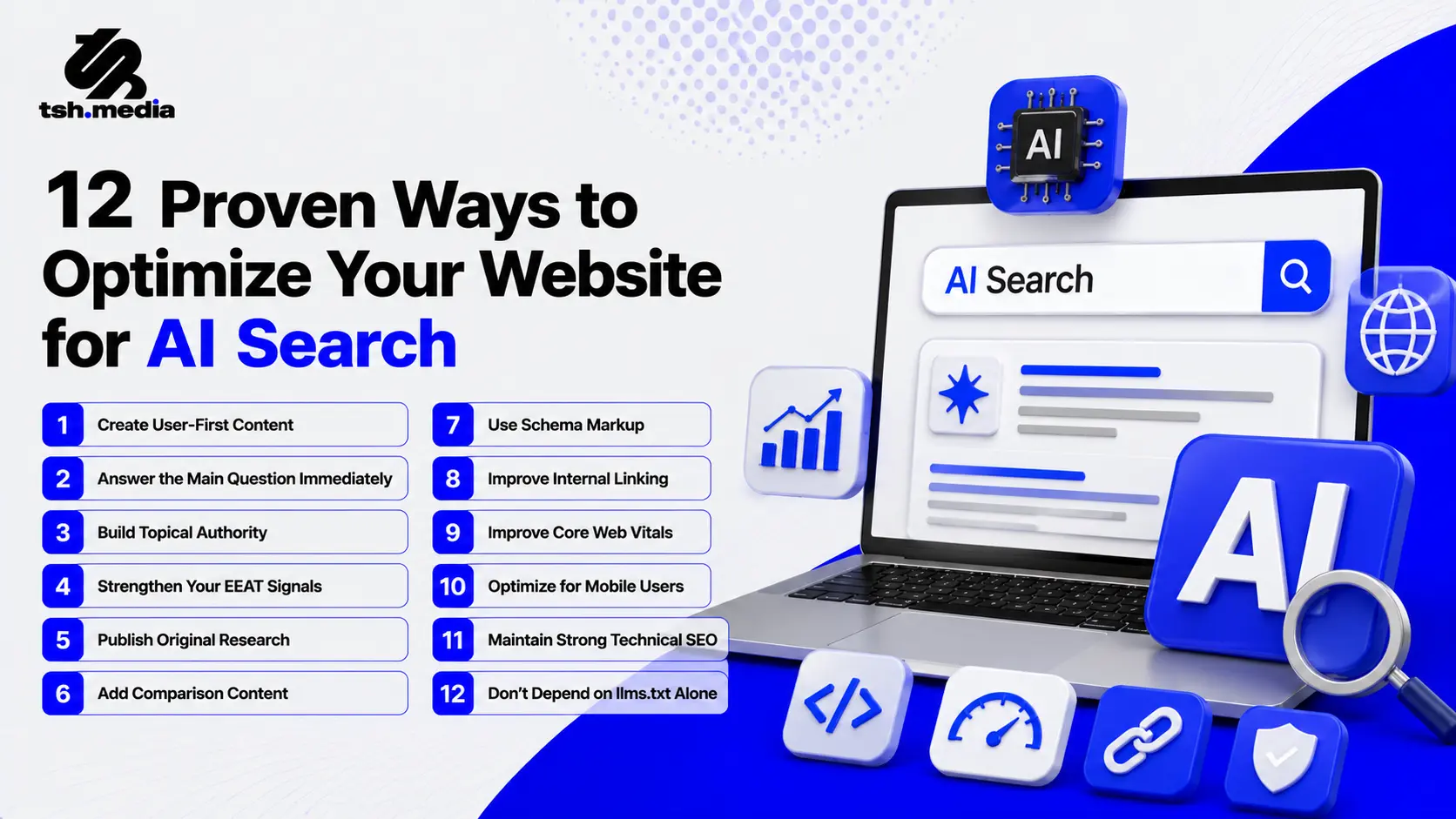
1. Create User-First Content
This is the biggest ranking factor.
Many businesses today create content hoping it gets cited in AI Overviews.
Instead, ask:
- What is my customer searching for?
- What problem are they trying to solve?
- What questions will they ask next?
If your page answers every important question, AI systems are much more likely to reference it.
2. Answer the Main Question Immediately
Don’t make users scroll through five paragraphs before reaching the answer.
The first section of your page should clearly answer the primary query.
Then expand into:
- Examples
- Step-by-step guides
- Best practices
- Common mistakes
- FAQs
This improves both user experience and AI readability.
3. Build Topical Authority
Publishing one article isn’t enough anymore.
Become the complete resource for your niche.
For example, if you’re a digital marketing agency, your content should cover:
- SEO
- AI SEO
- Generative Engine Optimization
- Google Ads
- Meta Ads
- Local SEO
- Technical SEO
- Content Marketing
- Link Building
- Website Speed Optimization
When AI systems see consistent expertise, they trust your website more.
4. Strengthen Your EEAT Signals
Experience, Expertise, Authoritativeness, and Trustworthiness are more important than ever.
Your website should include:
- Author information
- Business address
- Contact details
- About Us page
- Customer testimonials
- Case studies
- Certifications
- Awards
- Privacy Policy
- Terms & Conditions
Trust is a competitive advantage in AI Search.
5. Publish Original Research
One thing we’ve consistently observed at TSH Media is that AI systems are more likely to reference content containing unique insights.
Examples include:
- Industry surveys
- Customer data
- Internal case studies
- Performance benchmarks
- Original statistics
- Real campaign results
Don’t just summarize existing content.
Create content worth referencing.
6. Add Comparison Content
Comparison articles perform exceptionally well.
Examples include:
- SEO vs GEO
- ChatGPT vs Gemini
- Google Ads vs Meta Ads
- Shopify vs WooCommerce
These pages answer buying decisions, making them valuable for users and AI.
7. Use Schema Markup
Structured Data helps search engines better understand your content.
Important schema types include:
- Article
- FAQ
- Organization
- Person
- Breadcrumb
- Product
- Local Business
- Review
Schema isn’t a shortcut, but it’s an essential part of technical SEO.
8. Improve Internal Linking
Every page should support another page.
Good internal linking:
- Improves crawlability
- Builds topical authority
- Helps users discover related content
- Distributes page authority
Think of your website as a knowledge hub rather than a collection of isolated pages.
9. Improve Core Web Vitals
Your website should be:
- Fast
- Stable
- Responsive
Focus on:
- Image optimization
- Faster hosting
- Lazy loading
- Efficient code
- Better caching
A better user experience often translates into better search performance.
10. Optimize for Mobile Users
Most searches now happen on smartphones.
Your website should have:
- Responsive layouts
- Large touch targets
- Fast loading
- Readable fonts
- Clean navigation
A poor mobile experience affects both user engagement and discoverability.
11. Maintain Strong Technical SEO
Technical SEO remains the foundation of AI Search Optimization.
Regularly audit:
- XML Sitemap
- robots.txt
- Broken links
- Canonical tags
- Redirects
- Crawl errors
- HTTPS
- Index coverage
If AI systems cannot efficiently access your website, they are less likely to reference it.
12. Don’t Depend on llms.txt Alone
One of the biggest myths in AI SEO is that adding an llms.txt file automatically improves visibility.
It doesn’t.
We’ve seen businesses spend hours implementing llms.txt while ignoring:
- Slow websites
- Thin content
- Poor user experience
- Missing schema
- Weak internal linking
No single file can replace a great website.
Think of llms.txt as one small component, not the strategy.
Common AI SEO Myths
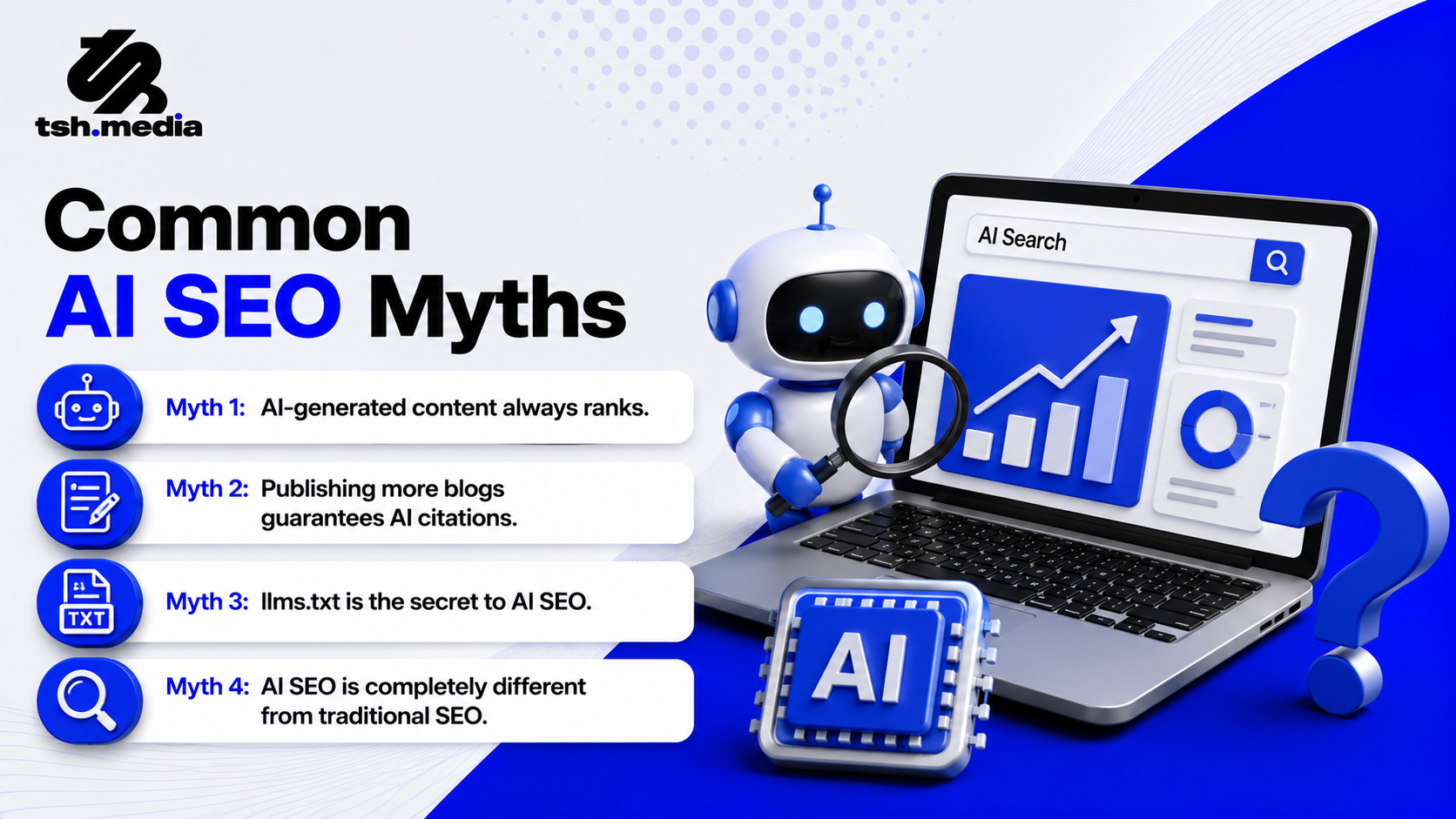
Myth 1: AI-generated content always ranks.
Reality:
AI-generated content can rank only when it’s reviewed, enhanced, and provides genuine value.
Myth 2: Publishing more blogs guarantees AI citations.
Reality:
Publishing 500 average articles is far less effective than publishing 50 exceptional ones.
Myth 3: llms.txt is the secret to AI SEO.
Reality:
Helpful content, strong technical SEO, and trust signals matter far more.
Myth 4: AI SEO is completely different from traditional SEO.
Reality:
AI Search builds on traditional SEO; it doesn’t replace it.
Essential Tools We Use at TSH Media
Helping businesses succeed in AI Search requires data-driven decisions.
Our team regularly uses:
- Google Search Console
- Google Analytics 4
- Ahrefs
- Screaming Frog
- Google PageSpeed Insights
- Schema Generators
- AI Content Analysis Tools
- Technical SEO Audit Platforms
- Keyword Research Tools
- Heatmap & User Behavior Tools
These tools help us identify opportunities, fix technical issues, and improve website performance.
A Simple AI SEO Checklist
Before publishing any page, ask yourself:
- Does it answer the user’s question?
- Is it better than the top-ranking content?
- Is it easy to read?
- Is it mobile-friendly?
- Does it load in under 3 seconds?
- Does it include schema markup?
- Does it have relevant internal links?
- Does it include original insights?
- Is it trustworthy?
- Would I confidently recommend this page to a customer?
If the answer is “yes” to all of these, you’re moving in the right direction.
How TSH Media Helps Businesses Optimize for AI Search
The future of search belongs to businesses that combine SEO, AI Search Optimization, and Generative Engine Optimization (GEO) into one cohesive strategy.
At TSH Media, we help businesses build websites that aren’t just optimized for search engines; they’re built to become trusted sources across AI-powered platforms like ChatGPT, Gemini, Perplexity, and Google AI Overviews.
Our AI SEO services include:
- AI Search Optimization
- Generative Engine Optimization (GEO)
- Technical SEO Audits
- Website Optimization
- Core Web Vitals Improvements
- Schema Markup Implementation
- Content Strategy
- SEO Content Writing
- Internal Linking Strategy
- Local SEO
- Enterprise SEO
- Website Performance Optimization
- SEO Consulting
Whether you’re a startup, eCommerce business, local company, healthcare provider, educational institution, or enterprise brand, our team creates long-term SEO strategies designed for the future of search.
Why Businesses Choose TSH Media
Unlike agencies that focus solely on rankings, we focus on business growth.
Our strategies are built around:
- Increasing qualified organic traffic
- Improving AI search visibility
- Enhancing user experience
- Generating more leads
- Building topical authority
- Creating content that earns trust
- Future-proofing your digital presence
Our philosophy is simple:
If your content genuinely helps users, AI platforms will naturally become more confident in recommending it.
Key Takeaways
Optimizing your website for ChatGPT, Gemini, Perplexity, and Google AI Overviews isn’t about finding shortcuts; it’s about building a website that deserves to be trusted.
Create content that answers real questions, invest in technical SEO, improve website performance, implement structured data, strengthen EEAT, and publish original insights that users can’t find elsewhere.
At TSH Media, we’ve seen firsthand that businesses focusing on user-first experiences consistently outperform those chasing AI SEO myths. As AI continues to reshape search, the brands that educate, solve problems, and build trust will be the ones that earn visibility, citations, and long-term growth.
If you’re ready to future-proof your online presence, now is the time to invest in a strategy that combines SEO, AI SEO, and Generative Engine Optimization (GEO), because the future of search has already arrived.
Frequently Asked Questions
ChatGPT can use retrieval systems and search integrations depending on the version and context. Making your content accessible, accurate, and well-structured improves the likelihood of it being surfaced.
GEO complements traditional SEO by optimizing content and website structure for AI-powered search engines and answer engines, while still relying on the same strong technical and content fundamentals.
Yes, but only if it’s accurate, original, reviewed by experts, and genuinely useful. Low-quality, mass-produced AI content rarely performs well over time.
Comparison articles, original research, statistical reports, tutorials, FAQs, case studies, and comprehensive guides tend to have the highest likelihood of being referenced by AI systems.
Absolutely. A fast, mobile-friendly website with strong Core Web Vitals provides a better user experience and supports stronger performance in both traditional and AI-powered search.